
Poetry

San Patricios

A land wrought with famine and strife

I boarded the floating coffin, hopeful for a new life

Landed in America, the officers already waiting

Tales of wages and land, I joined without hesitating

Took up arms to fight for the American dream

But arrived too late for some, and held in low esteem

Me and my countrymen kicked to the dust

Yet expected to fight in their war, it felt unjust

Still we fought, but not for them

We went to search for a new home once again

With their enemies we found shelter and friends

America marched on, no intention to make amends

Side by side, with every battle we’d lose another

But with every loss, those left would become closer than brothers

Alongside our new brethren we fought hard and true

We continued to defend Mexico, from those that let hatred spew

But luck runs out and now many of us are bound by chains

On Mexican soil I am destined to forever remain

I shall never again see my homeland

Close my eyes to picture the Emerald Island

For the momentously moving Mourne mountains, I mourn

To never again walk in the graceful glens, I scorn

As they tighten the rope, I open my eyes

To look upon this new landscape, this different sky

The colourful and vibrant homes of San Ángel, our safe haven

Home to a people who proved themselves no cravens

Under the still unfamiliar, but marvellous Mexican sun

It dawns on me that I’m at peace, and feel no need to run

I accept the rope, and prepare to die

For to die protecting my new home, I take great pride

– R. K. Lightfoot

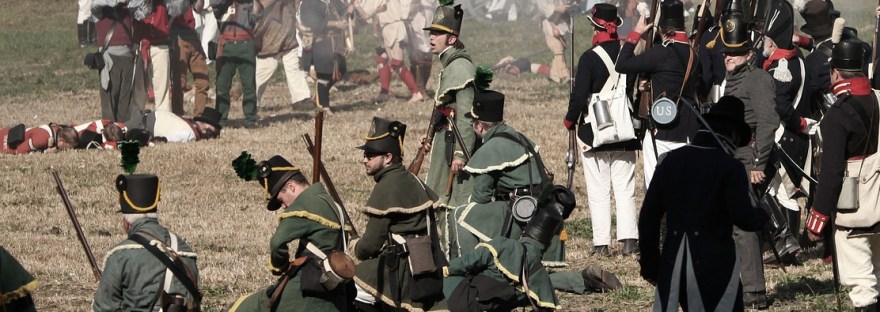
San Patricios is a poem about the Saint Patrick’s Battalion that fought for Mexico in the Mexican-American War (1846 to 1848). The poems name come from the battalion’s Spanish name Batallón de San Patricio, with the battalion often being referred to as the San Patricios. The battalion’s members included many who had deserted or defected from the U.S. Army, and was primarily composed of Irish Catholics, but not exclusively. The poem follows an unnamed Irishman in this battalion, who fled Ireland to escape famine and was immediately signed up to fight for the US in the Mexican-American War. But he soon becomes disenfranchised and joins the Mexican Army’s St. Patrick’s Battalion. He is eventually captured and sentenced to die. But before he is executed, the unnamed soldier comes to realisation that he views Mexico as his new home and the Mexicans he’s fought alongside as his fellow countrymen. Something he’s more than willing to die for.

© 2022
Photo via Pixabay CC0

Poetry

Douglas

A Douglas! A Douglas! Tender and true

In the name of the king, their swords they drew

Good Sir James, whose loyalty was profuse

To the Scottish King, Robert the Bruce

Leading the charge, Scotland’s enemies extinguished

Dubbed the Black Douglas by the fearful English

Loyal to his king, the pride of Douglas

On the journey to freedom, he remained the compass

A bond so strong, the Bruce entrusted his heart

Unfortunate their descendants tore it apart

Oh Douglas, Oh Douglas, Always Tender and True

But against you the king’s swords drew

On the Scottish throne sat King James, a boy of 10

And boy of 16, William Douglas, became a leader of men

The power of Douglas had grew and grew

Threatened felt the king’s council, the powerful few

‘Invite them to feast’, the Lord Chancellor did suggest

‘Invite them to your home, make them your guests’

The young Earl of Douglas, and his little brother did dine

Dinner with the king, who were they to decline?

A mighty feast the king eagerly ordered prepared

But by dinners end, neither brother would be spared

Before William Douglas, a special dish was placed

A black bulls severed head, whose sight left a bitter taste

Seized by the guards, mayhem captured the hall

‘Stop!’ cried the King. ‘What madness has taken you all?’

Ignored was the King, for he held no true sway

The council was where the guards true loyalties lay

Two brothers were dragged out to Castle Hill

And throughout Scotland swept an awful chill

The child called King made to stand and watch

The child called King powerless and distraught

A Douglas! A Douglas! Two boys tender and true

Oh Douglas, Oh Douglas. Two boys they slew

– R.K. Lightfoot

Douglas is a poem about some of the history of Clan Douglas. Chiefly focused on Sir James Douglas (aka ‘Good Sir James’ and ‘The Black Douglas’) and the infamous Black Dinner of 1440 (Supposedly the inspiration for the Red Wedding in A Song of Ice and Fire) in which some of his descendants were slaughtered. It’s been a fair amount of time since I wrote this poem, so it was nice to revisit it and finally get it posted. I still think the poems a little rough around the edges and in need of some future edits. I’ve left this blog unused for nearly four years now, its been far too long and its good to be back at it again.

© 2022
Photo via Pixabay CC0

Poetry

On Valentine’s

On Valentine’s, seven men stand along a brick wall.
Albert Kachellek, stands firm and tall.
Blood boiling beneath a stoic face,
The right hand determined to die with grace.

On Valentine’s, seven men stand along a brick wall.
John May, can do nothing but bawl.
Just the mechanic with a wife is his plea,
They reply with a laugh, that drips with horrid glee.

On Valentine’s, seven men stand along a brick wall.
Reinhardt Schwimmer, who the races had enthralled.
An optician with debt up to his eyes,
Accepts that he was destined for a bloody demise.

On Valentine’s, seven men stand along a brick wall.
Peter Gusenberg, whose sins could no longer be numbed by the alcohol.
Men, Women, Children. Had all felt his wrath,
Now a tired man shall pay for his odious path.

On Valentine’s, seven men stand along a brick wall.
Albert Weinshank, whose choice of coat and hat, prevented Moran’s downfall.
Capone’s hit thwarted by a similar taste in clothes,
So now Mrs Weinshank shall receive a rose.

On Valentine’s, seven men stand along a brick wall.
Adam Heyer, counts the bricks, waiting for whate’er befalls.
The bookkeeper who was happy to look the other way,
But on this day, he has been made the prey.

On Valentine’s, seven men stand along a brick wall.
Frank Gusenberg, outlasted them all.
Fourteen bullets and yet without a second thought,
When asked by police, he proclaimed he hadn’t been shot.

– R.K. Lightfoot

A poem about the Saint Valentine’s Day Massacre. I realise that its nowhere near Valentine’s Day but I couldn’t be bothered to wait until then to post this. Please let me know your thoughts in the comments.

© 2018
Photo via Pixabay CC0